Open-Weight vs Closed-Weight Models: What's the Difference?
OpenRouter ·
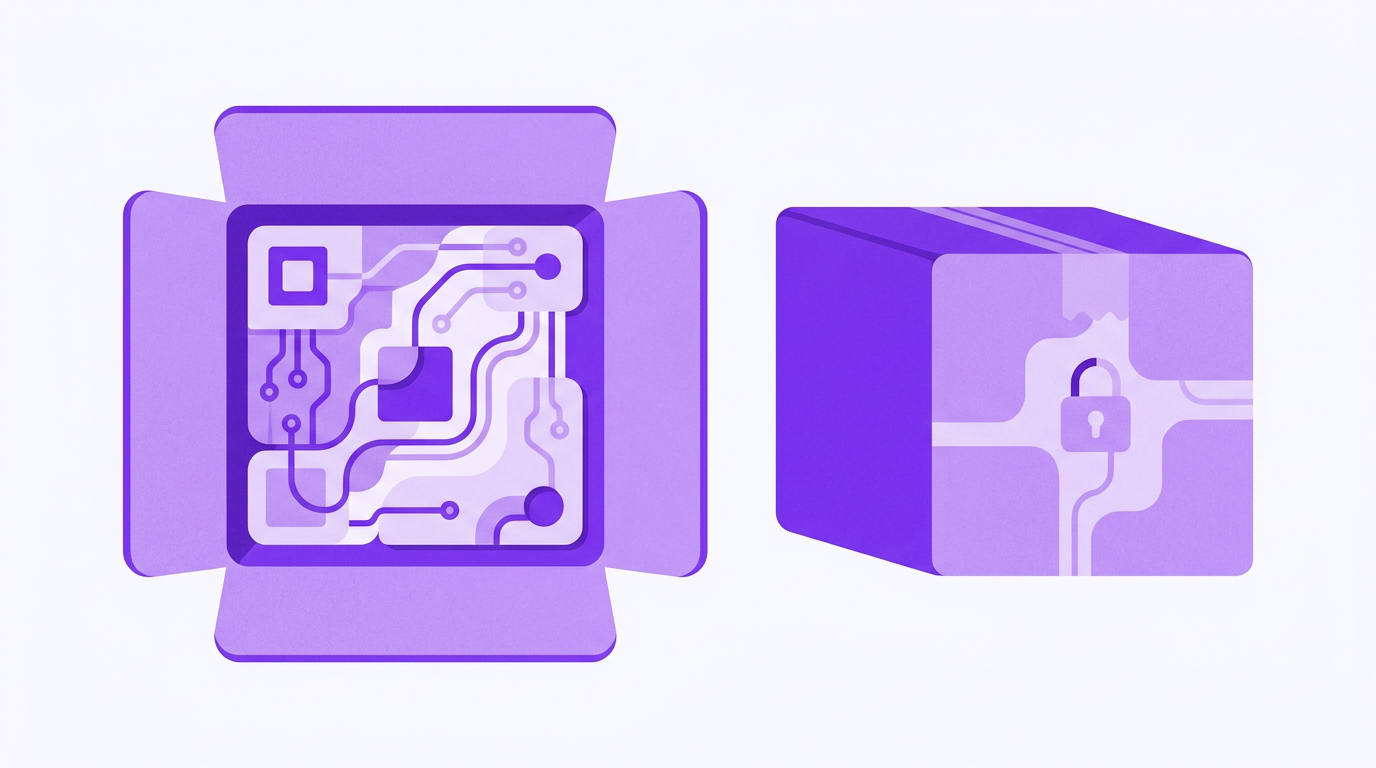

An open-weight model is one whose trained weights are published, so anyone can download it, run it on their own hardware, fine-tune it, or serve it to others. A closed-weight model keeps its weights private, so the only way to use it is through the company that built it or a cloud it licenses to.
Across OpenRouter, open-weight models went from 27% of the top 50 models’ tokens in October 2025 to 72% in late September 2026.
Tl;dr
- Open-weight models publish their weights, so anyone can run, fine-tune or serve them. Closed-weight models are only available from their maker and the clouds it licenses.
- Open-weight models handled 72% of the top 50 models’ tokens on OpenRouter in late September 2026, up from 27% a year earlier.
- They cost about a quarter as much per token, mostly because many providers compete to serve the same model.
- The best closed-weight models still score about 11 points higher on the Artificial Analysis Intelligence Index. Start on an open-weight model, test it, and use a closed-weight model for the steps that need it.
What is an open-weight model?
A model’s weights are the numbers it learned during training, and they’re what you download when you download a model. Publishing them, usually on Hugging Face, lets anyone run the model. DeepSeek V4.1 Flash, GLM-5.3, Kimi K3 and MiMo-V2.6-Pro are open-weight. Claude, GPT and Gemini models are closed-weight.
Publishing the weights doesn’t mean you can do anything you like with them. Licenses vary a lot. As we noted in our June roundup of open-weight models, DeepSeek V4 Flash shipped under the MIT license, while MiniMax M3’s community license requires attribution and asks larger commercial products to get written permission first. Check the model’s license before you build on it.
How is open weight different from open source?
Open source, in the Open Source Initiative’s sense, means you get what you need to study and rebuild it: for a model, that includes the training data (or detailed information about the data when it can’t legally be shared), the code and the weights.
Most open-weight models don’t release their training data, so “open weight” is the more accurate term for them. Search results and model pages use the words loosely, though, so when you see “open-source LLM,” it almost always means open-weight.
What do you get with each?
| Open-weight | Closed-weight | |
|---|---|---|
| Run it yourself | Yes, on your own GPUs | No |
| Fine-tune the weights | Yes | Only through the vendor’s fine-tuning API, if it has one |
| Who serves it | Anyone, with 20 to 31 providers for popular models on OpenRouter | The vendor and a few licensed clouds |
| List price on OpenRouter (token-weighted, last 4 weeks) | $0.28 in / $1.62 out per million tokens | $1.27 in / $6.36 out per million tokens |
| Best Artificial Analysis Intelligence Index score | 46.3 (MiMo-V2.6-Pro) | 57.6 (Claude Opus 5.5) |
The first two rows are why some teams need open weights. Their data can’t leave their own infrastructure, or they want a model fine-tuned on their own data. For everyone else, the choice comes down to the last three rows, and price is the one that usually decides it. The usage data shows why.
How much are developers using open-weight models?
Usage has grown every quarter. Early in 2026, MIT Sloan published research based on OpenRouter traffic from May to September 2025 that found closed models handled nearly 80% of tokens. Our own data from late 2025 looks similar, and it has changed a lot since.
We classified every model in OpenRouter’s top 50 by weekly token volume as open-weight or closed-weight, based on whether its catalog entry links to published weights:
| Week of | Open-weight share | Open-weight tokens | Closed-weight tokens |
|---|---|---|---|
| Oct 6, 2025 | 26.8% | 1.3T | 3.4T |
| Jan 26, 2026 | 35.1% | 2.6T | 4.9T |
| Apr 20, 2026 | 47.7% | 8.9T | 9.8T |
| Jul 20, 2026 | 77.5% | 41.1T | 11.9T |
| Sep 28, 2026 | 71.7% | 83.5T | 33.0T |
Both kinds grew. Closed-weight volume rose almost tenfold, from 3.4 trillion to 33 trillion tokens a week, while open-weight volume rose more than 60-fold. The open share peaked at 77.5% in July and has stayed above two-thirds since.
The most-used open-weight models over the last four weeks were DeepSeek V4.1 Flash, GLM-5.3 Flash, Hunyuan 4 Preview and DeepSeek V4 Flash. On the closed side, GPT-5.6 Luna led by a wide margin, followed by Gemini 3.8 Flash and GPT-6 Luna. On both sides, most of the volume goes to cheap, fast models rather than the highest-scoring ones.
Are open-weight models cheaper?
Usually they are. Over the last four weeks, the token-weighted list price for open-weight models was $0.28 per million input tokens and $1.62 per million output tokens. For closed-weight models, it was $1.27 and $6.36, about four times as much.
The main reason is competition. Anyone can serve an open-weight model, so providers compete on price for the same model. Here’s how many providers served six popular models on OpenRouter on October 21, 2026, and the spread of their input prices across endpoints:
| Model | Weights | Providers | Input price range, per million tokens |
|---|---|---|---|
| z-ai/glm-5.3-flash | Open | 30 | $0.04 to $1.15 |
| deepseek/deepseek-v4.1-flash | Open | 31 | $0.03 to $0.60 |
| moonshotai/kimi-k3 | Open | 20 | $0.24 to $4.50 |
| anthropic/claude-sonnet-5.5 | Closed | 5 | $2.00 to $2.20 |
| openai/gpt-6-luna | Closed | 3 | $0.05 to $0.20 |
| google/gemini-3.8-flash | Closed | 2 | $0.38 to $1.35 |
The ranges are wide for open-weight models because providers differ in hardware, quantization, speed and data policy. The cheapest endpoint isn’t always the one you want, and our guide to evaluating provider performance shows how to compare them. Provider routing lets you sort by price, filter by quantization or data policy, or set a price ceiling.
The two categories also overlap. Kimi K3’s cheapest endpoint costs less than Claude Sonnet 5.5, but its most expensive one costs about twice as much. GPT-6 Luna lists at $0.10 per million input tokens, less than any Kimi K3 provider charges. Compare the specific models you’re considering, not the categories.
Our shortcut for that comparison is to set the price ceiling first and sort whatever is left by throughput. It takes one provider object, {"max_price": {"prompt": 1, "completion": 4}, "sort": "throughput"}. Endpoints over your budget drop out, and the fastest one you can afford is tried first.
Are open-weight models as good as closed-weight models?
Price is one half of the trade-off, and quality is the other. Here, open-weight models aren’t at the top yet. On the Artificial Analysis Intelligence Index, as aggregated by our benchmarks endpoint, the best closed-weight scores were Claude Opus 5.5 at 57.6 and Claude Sonnet 5.5 at 56.0. The best open-weight scores were MiMo-V2.6-Pro at 46.3, GLM-5.3 at 44.8 and Step 5 Preview at 43.7, with Kimi K3 just behind at 43.6. Each score is the model at its highest reasoning effort setting.
The setting moves these numbers, so compare models at the effort you plan to run them at.
The 11-point gap is between the strongest models on the hardest tasks the index measures, and it doesn’t tell you how much the gap matters for your own workload. Our June roundup put it at about five points on an earlier version of the index, so treat the exact figure as a snapshot.
With an 11-point quality gap against a 4x price gap, our default is to start on an open-weight model and test it on your own tasks. Move to a closed-weight model only for the steps where the test shows the extra quality changes the result. That’s usually the hardest step in a workflow, such as planning in an agent, rather than every call.
How do you use both in one app?
We serve both kinds through the same API, so you can mix them without rewriting your app. List a closed-weight model first in the models array and an open-weight model after it as the fallback.
Our guide to how model routing works explains the order we try them in. This request also caps the price at $1 per million input tokens and $4 per million output tokens. Claude Sonnet 5.5 costs more than that, so we skip it and route the request to GLM-5.3 Flash:
import os
import requests

r = requests.post(
    "https://openrouter.ai/api/v1/chat/completions",
    headers={"Authorization": f"Bearer {os.environ['OPENROUTER_API_KEY']}"},
    json={
        "models": ["anthropic/claude-sonnet-5.5", "z-ai/glm-5.3-flash"],
        # USD per million tokens
        "provider": {"max_price": {"prompt": 1, "completion": 4}},
        "messages": [
            {"role": "user", "content": "In one sentence: what is an open-weight model?"}
        ],
    },
    timeout=120,
)

data = r.json()
print(r.status_code, data.get("model"), data.get("provider"))
print(data["choices"][0]["message"]["content"] if "choices" in data else data)
print(f"${data.get('usage', {}).get('cost', 0):.6f}")
200 z-ai/glm-5.3-flash Relace
An open-weight model is a machine learning model whose trained parameters (weights) are publicly released for anyone to download, run, inspect, and fine-tune, though typically without the training data or full development details that would make it fully "open-source."
$0.000023The model field in the response shows which model answered, and that’s the model you’re billed for. If you remove GLM-5.3 Flash from the list, the same request fails because no endpoint meets the cap:
404 {'error': {'message': 'No endpoints found that satisfy the max price for this request', 'code': 404,
  'metadata': {..., 'failed_routing_step': 'Filter by Max Price'}}}
A price cap is one trigger. Model fallbacks also move to the next model on rate limits, downtime, context-length errors and moderation refusals. With a closed-weight primary and an open-weight fallback, your app keeps answering when the primary vendor has an outage.
How we measured this
Every usage, price and benchmark figure in this post comes from our own APIs, and this section explains how we pulled and classified them. The usage numbers come from our public rankings dataset, which gives weekly token totals for the top 50 models. We used October 6, 2025 to September 28, 2026. A model counts as open-weight if its OpenRouter catalog entry links to a Hugging Face repository. We classified retired models that have left the catalog by publisher, where that was unambiguous.
Two kinds of volume are left out of the shares. The dataset’s “other” row, which combines everything outside the top 50, ranged from 0.3 to 10.8 trillion tokens a week. Stealth models are unannounced, so we can’t classify them, and they reached 38.7 trillion tokens in the most recent week. Token counts come from each provider’s own tokenizer, so they’re good for comparing trends but aren’t exact like-for-like counts. The token-weighted prices are list prices from our models and endpoints APIs on October 8, 2026. The provider counts and price ranges were pulled on October 21, 2026.
Frequently asked questions
Is Llama open source?
Llama is open-weight, not open source under the Open Source Initiative’s definition. Meta publishes the weights but not the training data, and the Llama license requires companies with more than 700 million monthly active users to request a separate license from Meta. Most LLMs described as open source are open-weight in the same way.
Can I run an open-weight model for free?
On your own hardware, the model is free but the GPUs aren’t. Through an API, several open-weight models have free variants on OpenRouter, with rate limits that our free LLM API comparison covers. Paid endpoints for popular open-weight models start at a few cents per million input tokens.
Is my data safer with an open-weight model?
Only if you run it yourself, so the data never leaves your servers. Through a hosted provider, what matters is that provider’s data policy, whichever kind of model it serves. On OpenRouter you can restrict requests to zero data retention endpoints for both kinds of model, per request or across your account.
Which open-weight model should I start with?
We’d start with DeepSeek V4.1 Flash. It’s the most-used open-weight model on OpenRouter, and 31 providers serve it, so routing it through OpenRouter keeps it available when one provider goes down. It also accepts images as well as text. When you need more capability, try GLM-5.3 or Kimi K3. The rankings page shows what developers are using right now.
Next steps
- Model fallbacks explains the
modelslist and what triggers a fallback. - Provider routing covers sorting, price ceilings, and the quantization and data-policy filters that matter most for open-weight models with many providers.
- The rankings page and benchmarks endpoint show the data behind this post, updated continuously.
- The open-weight models that matter, June 2026 is our roundup of individual models.